
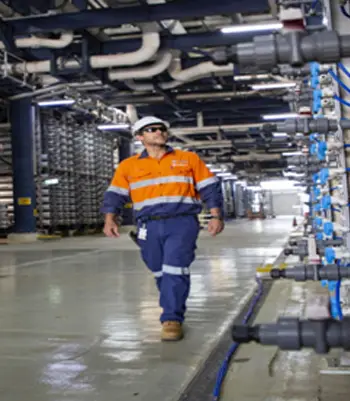
A wastewater treatment plant is no longer merely an environmental obligation; it has become a strategic pillar for the sustainability of any industrial or residential project. In light of today’s water challenges, the efficiency of wastewater treatment systems has become a decisive factor in the success of your investment.
In this article, we reveal the principles of successful engineering design and examine the components of a wastewater treatment plant and how they help reduce operating costs.
We will also take you on a technical journey through the stages of wastewater treatment and explain how wastewater is treated using the latest MBR and MBBR technologies, enabling us to transform wastewater into a renewable resource that efficiently supports your objectives.
What Is a Wastewater Treatment Plant?
A wastewater treatment plant is an integrated engineering system designed to remove organic, physical, and chemical pollutants, as well as microorganisms, from wastewater generated by domestic use or industrial activities.
Its primary purpose is to convert wastewater into environmentally safe treated water that complies with applicable standards or can be reused for irrigation and industrial cooling.
At Aqua Sana, we design and implement wastewater treatment systems based on a detailed study of the pollutants involved, using the latest international technologies, including:
SBR
MBR
MBBR
Compact Treatment Solutions
For projects without access to a centralized sewage network, we provide compact treatment units that are ready for installation immediately upon delivery. These units are manufactured from coated steel that can withstand harsh conditions, making them an ideal solution for:
Tourist resorts, residential compounds, and factories
Hospitals, schools, and military facilities
Construction sites, utility camps, and restaurants
Our designs also account for the treatment of sludge generated as a by-product, ensuring its safe disposal or rehabilitation. This makes our plants environmentally friendly and compliant with legal requirements.
Do you need a highly efficient wastewater treatment plant designed specifically for your project using the latest technologies? Contact Aqua Sana today.
Types of Wastewater Treatment Plants
Wastewater treatment plants vary according to the required treatment level and the desired quality of the resulting water. Wastewater passes through several stages designed to remove pollutants and improve its quality for discharge or reuse.
Primary treatment plants: These rely on physical processes such as screening, sedimentation, and oil and grease removal to eliminate suspended solids. This is the fundamental stage preceding biological treatment.
Secondary treatment plants: These use microorganisms to break down organic matter and reduce pollutants in the water, significantly improving its quality.
Tertiary treatment plants: These incorporate advanced processes such as filtration and disinfection using chlorine, ultraviolet light, or ozone to produce high-quality water suitable for reuse in agriculture and industry.
Compact treatment plants: These are prefabricated treatment units characterized by their small footprint and ease of installation and operation. They are suitable for locations with limited space, such as resorts, factories, and small communities.
Modern Wastewater Treatment Technologies
The efficiency of a treatment plant depends on selecting the technology best suited to the type of pollutants and the available space. At Aqua Sana, we design and implement our plants using the latest wastewater treatment systems to ensure the highest quality of treated water.
Sequencing Batch Reactor (SBR)
SBR is a system that uses the activated-sludge process in batches. Oxygen is introduced into the wastewater mixture to break down organic matter and reduce biochemical oxygen demand (BOD) and chemical oxygen demand (COD).
Advantages: SBR systems can be supplied as compact or containerized units with capacities of up to 1,000 cubic meters per day. They produce high-quality treated water suitable for surface discharge or the irrigation of non-food crops.
Moving Bed Biofilm Reactor (MBBR)
MBBR is an advanced biological process that uses mobile plastic carriers, or media, inside aeration tanks. These carriers increase the surface area available for bacterial growth.
Advantages: MBBR provides an economical and flexible solution for improving the efficiency of existing plants without expanding their tanks. It offers low energy consumption and a high capacity for removing organic matter, making it an excellent option for industrial projects and applications with less stringent environmental requirements.
Membrane Bioreactor (MBR)
MBR combines biological treatment with fine membrane filtration systems.
Advantages: It produces exceptionally high-quality treated water suitable for reuse in numerous applications. It also requires significantly less construction space than conventional systems.
Integrated Fixed-Film Activated Sludge (IFAS)
IFAS combines a conventional activated-sludge system with fixed biological media inside the treatment tank.
Advantages: It improves biological treatment efficiency and significantly increases the plant’s operating capacity without requiring major structural expansion.
These technologies are fundamental components of modern wastewater treatment systems. They enable plants to achieve maximum operating efficiency while reducing costs and space requirements, providing flexible solutions for various types of projects.
Components of a Wastewater Treatment Plant
A wastewater treatment plant consists of an integrated series of units operating in a precise engineering sequence, beginning with wastewater intake and ending with the production of safe water suitable for reuse.
The main components include:
Screening units: These form the plant’s first line of defense by capturing large solid materials such as plastics, wood, and fabric, thereby protecting downstream equipment.
Grit chambers: These separate heavy inorganic materials such as sand and gravel, protecting pumps and pipes from abrasion and damage.
Oil and grease traps: These remove floating oils and fatty substances that could interfere with biological treatment efficiency.
Equalization basins: These regulate flow rates and pollutant concentrations, reducing fluctuations and improving operating stability.
Primary sedimentation tanks: These remove settleable solids and reduce the organic load before biological treatment.
Aeration tanks: These introduce oxygen to activate the microorganisms responsible for breaking down organic matter.
Moving Bed Biofilm Reactor units: These use mobile biological media to improve treatment efficiency within a limited area.
Secondary clarifiers: These separate biological sludge from the treated water to achieve greater purity.
Tertiary treatment units: These incorporate filtration and disinfection processes to produce high-quality water suitable for reuse.
Sludge-handling units: These reduce and treat sludge to ensure its safe disposal or beneficial reuse.
The components of a wastewater treatment plant are essential to the success of the entire treatment system. Each component must be carefully designed to ensure seamless integration between all treatment stages and achieve optimum operating efficiency and final water quality.
Now, let us explain the wastewater treatment process in detail.
Wastewater Treatment Stages
Wastewater passes through four consecutive stages to convert it into environmentally safe water.
1. Preliminary Treatment
This stage improves the characteristics of the incoming water by reducing large pollutants. Mechanical screens remove solid waste such as wood and plastic, after which sand, oil, and grease are removed.
2. Biological Treatment
This is the principal stage of the wastewater treatment process and includes:
Aeration and mixing: Water is pumped into aeration tanks and mixed with activated sludge, where bacteria oxidize and break down organic matter.
Sedimentation: The water moves to circular sedimentation tanks, where decomposed organic matter settles at the bottom. Floating deposits are skimmed from the surface to ensure that the water is sufficiently clear before entering the next stage.
3. Tertiary Treatment and Disinfection
This stage disinfects the water and ensures its complete purification:
Disinfection: Chlorine is injected into the water to eliminate bacteria and viruses.
Filtration: Water passes through sand filters to remove fine solid particles. The filters are periodically cleaned through backwashing.
Monitoring: Water is tested in the plant’s laboratories to confirm compliance with environmental standards before it is used for agricultural irrigation.
4. Sludge Treatment
Sludge collected from the sedimentation tanks undergoes the following processes:
Thickening and digestion: These processes reduce the sludge volume and remove pollutants through aeration.
Drying: The sludge is dried in dedicated beds through evaporation and natural filtration across layers of sand and gravel. It can then be safely disposed of or reused as fertilizer after appropriate treatment.
Wastewater Treatment Plant Design Standards
At Aqua Sana, we conduct a detailed assessment of your project to design a wastewater treatment plant that complies with environmental standards, delivers maximum operating efficiency, and protects the long-term sustainability of your investment.
Our design process includes:
Analysis of flow rates and organic loads: We examine incoming water volumes, seasonal variations, and pollutant loads to identify the most suitable treatment technology.
Site and infrastructure assessment: We consider the available space, operating conditions, and existing utilities when preparing the design.
Compliance with environmental and health standards: We apply environmental, health, and safety requirements in accordance with approved standards and best practices.
Regulatory compliance: We ensure that the plant’s design satisfies the requirements of the relevant authorities and regulatory bodies.
Economic efficiency: We assess construction, operation, and maintenance costs to select solutions that provide the best return on investment.
Planning for future expansion: We design flexible systems that allow the plant’s capacity to be increased when required.
Specialized engineering studies: We conduct feasibility studies and hydraulic modeling to evaluate different alternatives and select the optimal solution for the project.
Integrated Wastewater Treatment Solutions from Aqua Sana
Ultimately, a wastewater treatment plant is essential for protecting water resources and achieving environmental sustainability through advanced treatment technologies. As these solutions continue to evolve, treatment plants are becoming increasingly efficient in producing safe water suitable for reuse.
Contact Aqua Sana today for integrated solutions covering the design, construction, operation, and maintenance of wastewater treatment plants using the latest technologies and delivering the highest levels of efficiency.